

Address
18, Bahir Sarbamangala Road, Punjabi Para, Subhas Pally, East Burdwan, West Bengal, India - 713101
Get In Touch
9332416765
Mail Us
info@pinkshadowmedia.com
Recent Blogs
October 16, 2026

October 12, 2026
 Change Language
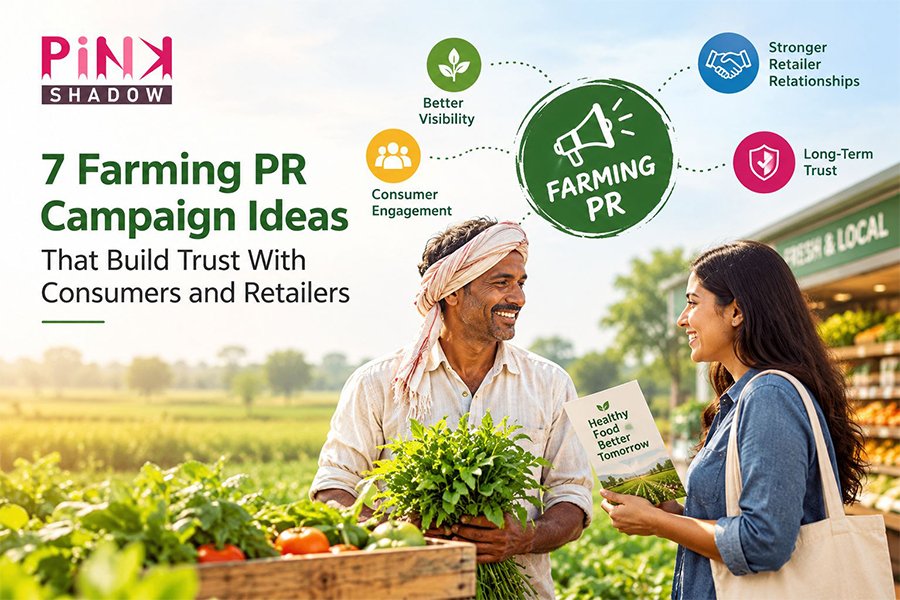
7 Farming PR Campaign Ideas That Build Trust With Consumers and Retailers

Agriculture is more than producing crops. It is about building relationships with farmers, consumers, retailers, distributors, and other industry stakeholders. For agricultural brands, trust plays an important role in purchasing decisions, product awareness, and long-term business growth.
A well-planned agricultural PR campaign helps businesses communicate their values, share useful information, build credibility, and strengthen relationships with their target audiences. From farmer success stories to product demonstrations, public relations can help agricultural businesses create meaningful connections with the people who matter most.
At Pink Shadow Media, we understand the importance of strategic communication and audience engagement for agricultural businesses. Here are seven practical farming PR campaign ideas that can help build trust with consumers and retailers.
1. Share Real Farmer Success Stories
Real experiences can make an agricultural brand more relatable and trustworthy. Sharing stories from farmers who use a company's seeds, fertilizers, agricultural equipment, or other products can help audiences understand their practical applications.
An effective campaign can include farmer interviews, field photographs, short videos, and detailed case studies. Explain the challenges farmers faced, the solutions they tried, and the results they observed. Make sure all claims are accurate and supported by evidence.
How to implement this idea:
- Interview farmers who have genuine experience with your products.
- Publish their stories on your website and social media channels.
- Create short videos highlighting farming practices and experiences.
- Share case studies with agricultural retailers and distributors.
Farmer-led storytelling gives agricultural brands an opportunity to communicate through real experiences rather than promotional claims alone.
2. Organize Agricultural Product Demonstrations
Product demonstrations allow farmers and retailers to understand how agricultural products work in real-world conditions. They are particularly useful for seed companies, fertilizer manufacturers, irrigation equipment suppliers, and agricultural technology businesses.
A demonstration campaign can introduce a new product, explain its features, or help farmers understand correct usage. Retailers can also participate to learn how to communicate product benefits to customers.
Ways to organize a successful demonstration:
- Arrange field demonstrations or local product education events.
- Invite farmers, dealers, distributors, and agricultural experts.
- Provide clear product information and practical demonstrations.
- Capture photographs and videos for follow-up communication.
- Collect participant feedback to improve future campaigns.
A transparent demonstration can strengthen product understanding and help retailers communicate with greater confidence.
3. Build Stakeholder Engagement Campaigns
Successful agricultural communication involves more than reaching end consumers. Farmers, retailers, distributors, agricultural experts, local communities, and industry organizations can all influence how a brand is perceived.
Well-planned stakeholder campaigns in agriculture PR help businesses communicate relevant information to different audiences while building stronger professional relationships.
For example, a seed company might organize dealer meetings, farmer awareness sessions, and expert discussions around a product launch. Each activity serves a different audience but supports the same communication objective.
Practical stakeholder engagement ideas:
- Conduct retailer and distributor meetings.
- Organize farmer education sessions.
- Invite agricultural experts to share relevant knowledge.
- Develop regular newsletters for business partners.
- Gather feedback from stakeholders after each campaign.
These stakeholder campaigns in agri-PR can help agricultural businesses maintain consistent communication, understand audience concerns, and build long-term relationships.
4. Use Agricultural Media Relations and Press Releases
Agricultural media relations can help brands communicate important developments to relevant industry audiences. Press releases, expert commentary, interviews, and media stories can support awareness when there is genuinely newsworthy information to share.
Agricultural businesses can use media outreach to announce new products, farmer education initiatives, sustainability projects, industry partnerships, or significant business developments.
Best practices for agricultural media outreach:
- Identify publications that cover agriculture, farming, food production, and agribusiness.
- Prepare clear press releases with accurate information.
- Provide useful quotes from company representatives or qualified experts.
- Include supporting photographs, research, or other relevant materials.
- Respond promptly to media enquiries and requests for clarification.
Focus on useful, verifiable information rather than publishing press releases solely to promote a brand. Relevant media coverage can help improve credibility and introduce the business to new audiences.
5. Create Educational Campaigns for Farmers and Consumers
Education is an effective way to build trust because it provides value before asking people to make a purchase. Agricultural brands can develop communication campaigns that explain farming techniques, product applications, seasonal considerations, and responsible agricultural practices.
For example, a fertilizer company could publish guidance on soil testing and nutrient management. An irrigation equipment business could explain water-saving techniques. A food producer could share information about sourcing and production practices.
Content formats to consider:
- Educational articles and practical guides.
- Short instructional videos.
- Expert interviews and question-and-answer sessions.
- Infographics explaining agricultural processes.
- Farmer workshops and awareness programmes.
Keep educational content accurate, easy to understand, and relevant to the intended audience. Where technical recommendations are involved, use qualified experts and reliable sources.
Educational campaigns help position a business as a useful source of information instead of simply another seller competing for attention.
6. Highlight Sustainability and Responsible Farming Initiatives
Consumers and business partners increasingly want to understand how agricultural products are produced and how companies approach environmental responsibility. Agricultural brands can use PR campaigns to explain genuine initiatives involving soil health, water management, waste reduction, responsible sourcing, or farmer education.
However, sustainability communication must be transparent. Avoid broad environmental claims unless they can be substantiated.
Ideas for a responsible farming PR campaign:
- Share documented water conservation initiatives.
- Explain programmes that support responsible soil management.
- Highlight farmer training and awareness activities.
- Publish measurable progress reports where reliable data exists.
- Share interviews with participating farmers and technical experts.
For retailers, distributors, and consumers, credible communication can make it easier to understand a company's priorities and commitments.
The key is to communicate actual actions and measurable progress rather than relying on vague claims about being environmentally friendly.
7. Combine Digital PR With Social Media Storytelling
Traditional PR and digital communication can work together to help agricultural brands reach different audiences. Media coverage, social media content, website articles, email newsletters, and video campaigns can reinforce the same message across multiple channels.
A coordinated farming PR campaign can begin with a product announcement or farmer event and continue through follow-up stories, expert interviews, educational posts, and retailer communication.
How to coordinate a digital PR campaign:
- Publish the main announcement or story on your website.
- Share relevant highlights through social media.
- Create short videos featuring genuine farmer or expert experiences.
- Send campaign updates to retailers and distributors.
- Monitor audience questions, engagement, referral traffic, and enquiries.
Use each platform according to its audience and purpose. Social media engagement alone does not prove that a campaign has built trust, so combine digital metrics with feedback, stakeholder responses, and meaningful business outcomes.
How Pink Shadow Media Can Support Agricultural Brand Communication
Agricultural businesses need communication strategies that reflect their products, target audiences, and business objectives. A campaign designed for a seed company may require a different approach from one created for an agricultural equipment manufacturer or food producer.
Pink Shadow Media helps businesses strengthen their digital presence through strategic marketing, content development, social media communication, video production, and audience-focused promotional activities.
For agriculture-focused businesses, an integrated approach can support:
- Agricultural brand awareness and product communication.
- Farmer-focused educational content.
- Digital storytelling and video campaigns.
- Communication with retailers and distributors.
- Consistent messaging across digital channels.
By combining relevant content with clear communication objectives, agricultural businesses can build stronger connections with their audiences and support long-term brand development.
Conclusion
A successful agricultural PR campaign is built on credibility, useful communication, and meaningful relationships. Farmer success stories, product demonstrations, stakeholder engagement, media relations, educational content, sustainability communication, and digital storytelling all offer practical ways to build trust with consumers and retailers.
The most effective approach is to select campaign ideas that match your audience, communicate verifiable information, and measure outcomes consistently.
At Pink Shadow Media, we believe agricultural brands can create more meaningful connections when their marketing focuses on audience needs, transparent communication, and long-term relationships rather than short-term promotion.
FAQs
1. What is an agricultural PR campaign?
An agricultural PR campaign is a planned communication strategy that helps agriculture businesses build brand awareness, establish credibility, and strengthen relationships with farmers, consumers, retailers, distributors, and other industry stakeholders.
2. What are the best farming PR campaign ideas?
Effective farming PR campaign ideas include sharing farmer success stories, organizing product demonstrations, conducting stakeholder engagement programmes, distributing press releases, creating educational content, promoting sustainable farming initiatives, and using digital storytelling.
3. How can agricultural PR campaigns build trust with consumers?
Agricultural PR campaigns can build consumer trust through transparent communication, authentic farmer stories, verified product information, educational content, and evidence-based sustainability initiatives. Consistent and honest messaging helps consumers better understand an agricultural brand.
4. What are stakeholder campaigns in agriculture PR?
Stakeholder campaigns in agriculture PR are communication initiatives designed to engage farmers, retailers, distributors, agricultural experts, local communities, and industry organizations. These campaigns help businesses share relevant information, understand stakeholder concerns, and develop long-term relationships.
5. Why are stakeholder campaigns important in agri-PR?
Stakeholder campaigns in agri-PR help agricultural businesses communicate with different audiences more effectively. They support product awareness, encourage feedback, strengthen dealer relationships, and create opportunities for collaboration between agricultural brands and their partners.
6. How can agricultural businesses build stronger relationships with retailers?
Agricultural businesses can strengthen retailer relationships through regular communication, dealer education programmes, product demonstrations, promotional materials, retailer meetings, and responsive customer support. Sharing accurate product information also helps retailers communicate confidently with customers.
7. How can social media support a farming PR campaign?
Social media supports farming PR campaigns by distributing farmer testimonials, educational videos, product updates, event highlights, and agricultural success stories. It also allows brands to answer questions, collect feedback, and maintain communication with farmers, retailers, and consumers.
8. How can agricultural companies measure PR campaign success?
Agricultural companies can measure PR campaign success through relevant media coverage, audience reach, website referral traffic, event participation, stakeholder feedback, social media engagement, qualified enquiries, and attributable conversions. The most useful metrics depend on the campaign's objectives.
9. What role does video production play in agricultural PR campaigns?
Video production helps agricultural brands demonstrate products, share farmer experiences, explain farming practices, and communicate company initiatives. Authentic field videos and expert interviews can make complex agricultural information easier to understand and share across websites and digital platforms.
10. How can Pink Shadow Media help agricultural businesses with PR and marketing?
Pink Shadow Media supports businesses through digital marketing, content development, social media communication, video production, and audience-focused promotional strategies. These services can help agricultural brands improve online visibility, communicate product value, engage stakeholders, and build stronger relationships with their target audiences.

Let’s Elevate Your Digital Presence
You have a powerful story; We provide the strategy, creativity, and technology to handle all your marketing needs under one roof. Ready to see results?

