

Address
18, Bahir Sarbamangala Road, Punjabi Para, Subhas Pally, East Burdwan, West Bengal, India - 713101
Get In Touch
9332416765
Mail Us
info@pinkshadowmedia.com
Recent Blogs
October 16, 2026

October 12, 2026
 Change Language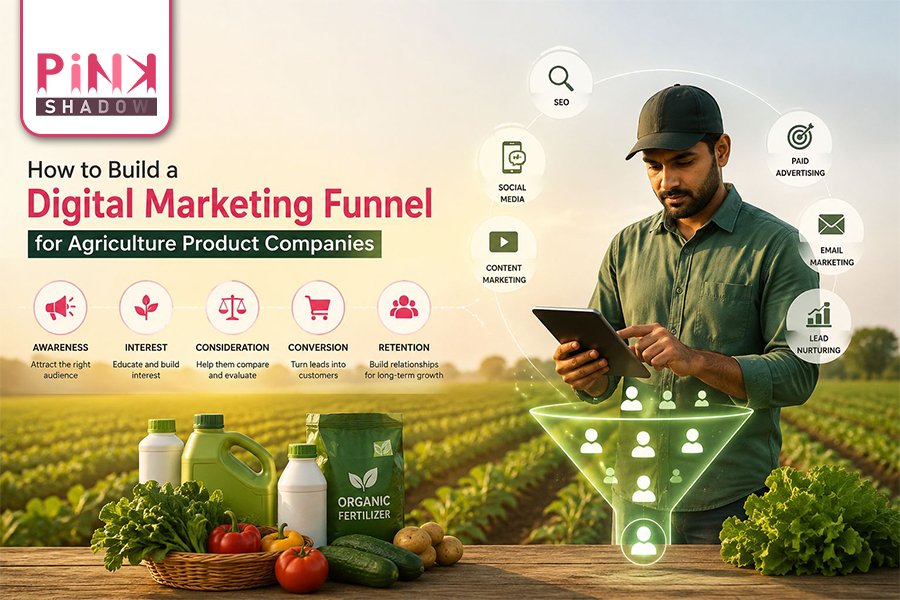
How to Build a Digital Marketing Funnel for Agriculture Product Companies

Agriculture product companies operate in a market where trust, product knowledge, timing, and regional reach strongly influence purchasing decisions. Whether a business sells seeds, fertilizers, pesticides, agricultural equipment, organic products, or other farm inputs, reaching the right audience requires more than simply running advertisements.
A well-planned Digital Marketing for Agricuture Product strategy can help agriculture businesses attract potential customers, educate them, generate qualified leads, and turn those leads into long-term customers. The key is to build a digital marketing funnel that guides prospects through every stage of their buying journey.
For agriculture brands, this funnel can combine SEO, content marketing, social media, video marketing, paid advertising, WhatsApp communication, and rural digital marketing to create a consistent path from awareness to conversion.
What Is a Digital Marketing Funnel for Agriculture Products?
A digital marketing funnel represents the stages a potential customer passes through before becoming a buyer.
For agriculture product companies, the funnel generally includes:
Awareness → Interest → Consideration → Lead Generation → Conversion → Retention
The purpose is to provide useful information at each stage rather than immediately asking every visitor to purchase a product.
An effective digital marketing for agriculture products strategy understands that farmers, distributors, retailers, and agribusiness decision-makers may have different questions and buying requirements.
Step 1: Identify Your Target Agriculture Audience
Before building your funnel, clearly define who you want to reach.
Your target audience could include:
- Farmers and growers
- Agricultural retailers
- Distributors and dealers
- Large agribusinesses
- Farming communities
- Food and agricultural businesses
- Procurement professionals
Create audience segments based on location, crop type, farming requirements, business size, and purchasing behavior.
For example, a company selling crop protection products may need different content for rice farmers in West Bengal than for vegetable growers in Bihar.
Audience segmentation makes agriculture digital marketing more relevant and improves the chances of generating qualified leads.
Step 2: Build Awareness With Educational Content
The top of the funnel is about getting discovered.
Instead of focusing only on product promotions, create educational content that answers real agricultural questions.
Useful content formats include:
- SEO-optimized agricultural blogs
- Short educational videos
- Crop-specific guides
- Infographics
- Social media posts
- YouTube tutorials
- Product education pages
- Farmer-focused FAQs
For example, an agricultural company could publish content about “How to Choose the Right Fertilizer for Paddy” or “Common Pest Problems in Vegetable Crops.”
This approach supports digital marketing for farmers by providing practical information while introducing the brand naturally.
Step 3: Capture Interest With Valuable Resources
Once people discover your brand, the next objective is to turn anonymous visitors into identifiable prospects.
Offer something useful in exchange for contact information, such as:
- Crop management guides
- Product catalogues
- Farming checklists
- Agricultural e-books
- Dealer information
- Product comparison guides
- Expert consultation requests
Create dedicated landing pages for different products and audience segments.
For example, a pesticide company could create a landing page specifically for farmers searching for solutions to a particular crop disease.
This makes agriculture lead generation more focused and measurable.
Step 4: Nurture Leads With Relevant Information
Not every lead is ready to buy immediately.
Lead nurturing is therefore an important part of digital marketing for agribusiness. Once a prospect provides contact information, continue communicating with useful and relevant content.
Businesses can use:
- Email marketing
- WhatsApp communication
- SMS campaigns
- Retargeting advertisements
- Educational videos
- Product demonstrations
- Case studies
Avoid sending only promotional messages. Instead, answer common questions, explain product benefits, share application information where appropriate, and demonstrate how your products solve real agricultural problems.
A useful nurturing sequence could be:
Day 1: Educational guide
Day 3: Product information
Day 7: Demonstration or case study
Day 10: Frequently asked questions
Day 14: Consultation or dealer enquiry
Step 5: Use Local and Rural Digital Marketing
Agricultural businesses often serve audiences beyond major cities. Therefore, rural digital marketing should be an important part of the funnel.
Create location-specific campaigns for states, districts, and agricultural regions where your products are available.
Consider:
- Regional-language content
- Local SEO
- WhatsApp campaigns
- Regional social media advertising
- Mobile-friendly landing pages
- Local dealer pages
- Farmer-focused videos
Regional-language video content can be particularly useful because it makes complex agricultural information easier to understand and increases familiarity with the brand.
Step 6: Convert Qualified Leads Into Customers
At the bottom of the funnel, prospects need a clear reason and simple process to take action.
Your landing pages should communicate:
- Product benefits
- Suitable applications
- Availability
- Dealer/distributor information
- Brand credibility
- Customer support options
- Clear calls to action
Useful CTAs include:
“Request Product Information”
“Contact a Dealer”
“Talk to Our Agriculture Expert”
“Request a Callback”
For B2B agriculture companies, the conversion may not always be an immediate sale. A distributor enquiry, dealer registration, quotation request, or sales consultation can also be a valuable conversion.
Step 7: Retarget Interested Prospects
Many visitors will leave your website without converting. Retargeting allows agriculture brands to reconnect with people who have previously interacted with their content or website.
For example, someone who visits a fertilizer product page could later see an advertisement featuring a product guide or educational video.
Retargeting can help move prospects back into the consideration stage without repeatedly targeting completely new audiences.
Step 8: Measure and Improve the Funnel
A digital funnel should be continuously measured and improved.
Important metrics include:
- Website traffic
- Organic search visibility
- Landing-page conversion rate
- Cost per lead
- Lead quality
- Form submissions
- WhatsApp enquiries
- Advertisement performance
- Sales-qualified leads
- Customer acquisition cost
If a landing page receives substantial traffic but generates few enquiries, review the content, offer, page experience, and call-to-action.
If advertisements generate many leads but few qualified prospects, improve audience targeting and lead qualification.
Data-driven optimization helps make agricultural product marketing more efficient over time.
How Pink Shadow Media Can Help Agriculture Product Companies
Building an effective funnel requires coordination between strategy, content, SEO, advertising, social media, landing pages, and lead management.
Pink Shadow Media helps businesses develop digital marketing strategies designed around their target audience, products, locations, and business objectives.
From agriculture digital marketing and SEO to content creation, lead generation, social media, Google Ads, video marketing, and rural-focused campaigns, an integrated strategy can help agriculture brands build visibility and create a stronger path from online discovery to customer enquiry.
Conclusion
A successful agriculture marketing funnel is not simply about attracting website visitors. It is about creating a structured journey that educates potential customers, builds trust, captures leads, nurtures prospects, and encourages meaningful action.
By combining Digital Marketing for Agricuture Product with SEO, educational content, lead generation, regional campaigns, retargeting, and performance measurement, agriculture product companies can build a scalable digital presence and reach customers more effectively.
The most successful strategy is one that puts the audience first: understand their problems, provide useful information, make the buying journey simple, and continue building relationships after the first conversion.
FAQs
1. What is a digital marketing funnel for agriculture product companies?
A digital marketing funnel is a structured process that moves potential agriculture customers from awareness to interest, consideration, lead generation, conversion, and retention using digital channels such as SEO, social media, content, advertising, email, and WhatsApp.
2. Why is digital marketing important for agriculture products?
Digital marketing helps agriculture product companies reach farmers, dealers, distributors, and agribusiness customers online. It can increase brand visibility, educate audiences, generate enquiries, and support measurable customer acquisition.
3. What are the best digital marketing strategies for agriculture products?
SEO, agricultural content marketing, social media marketing, video marketing, Google Ads, local SEO, WhatsApp marketing, lead-generation campaigns, and rural digital marketing are effective strategies when matched with the right audience and objectives.
4. How can agriculture companies generate leads online?
Agriculture companies can generate leads through optimized landing pages, enquiry forms, product guides, downloadable resources, Google Ads, social media campaigns, SEO content, WhatsApp campaigns, and dealer or distributor enquiry forms.
5. How does SEO help agricultural product companies?
SEO helps agriculture businesses appear when potential customers search for products, farming solutions, agricultural information, suppliers, or dealers. It can generate relevant organic traffic and support long-term visibility.
6. What type of content works for digital marketing for farmers?
Educational videos, crop guides, farming tips, product explainers, FAQs, demonstrations, infographics, regional-language content, and problem-solving articles can work well for farmer-focused audiences.
7. Is rural digital marketing useful for agriculture businesses?
Yes. Rural digital marketing can help brands reach audiences in agricultural regions through mobile-friendly websites, regional-language content, social media, WhatsApp, local SEO, and targeted digital advertising.
8. How long does it take to generate agriculture leads through digital marketing?
The timeframe varies depending on the industry, audience, competition, budget, website quality, and marketing channels. Paid campaigns can generate enquiries relatively quickly, while SEO and content marketing generally require consistent long-term effort.
9. What should an agriculture product landing page include?
A landing page should clearly explain the product, its benefits, relevant applications, availability, supporting information, trust signals, contact options, and a strong call-to-action such as requesting information, contacting a dealer, or requesting a callback.
10. How can Pink Shadow Media help with agriculture digital marketing?
Pink Shadow Media can support agriculture businesses with SEO, content marketing, social media, Google Ads, lead generation, video marketing, rural digital marketing, website development, and integrated digital strategies designed to improve visibility and generate business enquiries.

Let’s Elevate Your Digital Presence
You have a powerful story; We provide the strategy, creativity, and technology to handle all your marketing needs under one roof. Ready to see results?

