

Address
18, Bahir Sarbamangala Road, Punjabi Para, Subhas Pally, East Burdwan, West Bengal, India - 713101
Get In Touch
9332416765
Mail Us
info@pinkshadowmedia.com
Recent Blogs
October 5, 2026

September 29, 2026
 Change Language
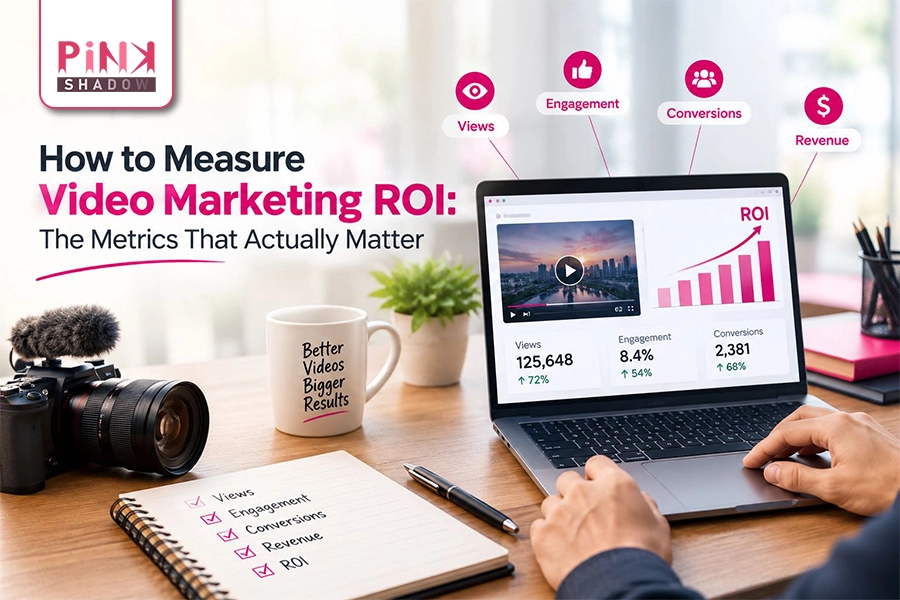
How to Measure Video Marketing ROI: The Metrics That Actually Matter

Your video hits 50,000 views, the team celebrates, and then someone asks, "But did it bring us any business?" Silence.
Measuring video marketing ROI doesn't have to be complicated, but it means looking beyond the numbers that are easiest to see. Whether you work with a video marketing company or manage videos in-house, this guide covers the formula, the metrics that matter at each stage of the customer journey, and how to connect video to revenue.
What Is Video Marketing ROI?
Video marketing ROI compares what your videos earn with what you spend on them:
ROI (%) = (Revenue from video − Total video cost) ÷ Total video cost × 100
A positive result means the video earned more than it cost. The hard part is measuring both sides accurately, and most brands get the cost side wrong.
Step 1: Calculate Your Total Video Cost
Many brands count only the production invoice. A realistic figure includes:
- Pre-production: scripting, concept, casting and locations
- Production: crew, equipment, talent and studio charges for video shooting for brands
- Post-production: editing, motion graphics, sound, subtitles and regional-language versions
- Distribution: paid ads, creator fees and promotion tools
- Internal time: hours your team spends managing and publishing
If you repurpose one shoot into many assets, measure cost across the whole shoot. The same production spend spreads over more assets, which improves your ROI.
Step 2: Match Metrics to the Funnel Stage
Not every video has the same job, so don't judge them all by the same number. A brand film built for awareness shouldn't be measured by sales alone, and a product demo shouldn't be judged by views.
- Awareness: are the right people seeing it? Track reach, view-through rate, cost per view and branded search growth.
- Engagement: do they care? Track average watch time, completion rate, retention curves, and shares or saves. The retention curve shows exactly where viewers drop off.
- Consideration: are they moving closer to buying? Track click-through rate, traffic from video, and sign-ups through email or WhatsApp.
- Conversion: is it driving business? Track conversion rate, leads generated, cost per lead (CPL), cost per acquisition (CPA) and revenue influenced.
- Retention: does it help after the sale? Track support ticket reduction, repeat purchases and onboarding completion for tutorial videos.
The Metrics That Actually Matter
If you track only a few numbers, choose these:
- Cost per lead or acquisition, because it ties video directly to money.
- Conversion rate, because it shows whether the video persuades.
- Completion rate, because it shows whether the content holds attention.
- Revenue influenced, because it proves business impact.
Views and likes aren't worthless, but on their own they're vanity metrics. High views with no enquiries usually means the video attracted attention but not the right audience, or lacked a clear call to action.
A Worked Example (Illustrative)
- Production and editing: ₹2,00,000
- Paid promotion: ₹1,00,000
- Total cost: ₹3,00,000
- Leads: 150, with 10% becoming customers (15)
- Average sale value: ₹60,000
- Revenue: ₹9,00,000
ROI = (9,00,000 − 3,00,000) ÷ 3,00,000 × 100 = 200%
Cost per lead = ₹2,000
Cost per customer = ₹20,000
These figures are invented to show the method. Use your own numbers.
Step 3: Set Up Tracking Before You Publish
You can't measure what you didn't track. Before launch:
- Add UTM parameters to every video link.
- Install the Meta Pixel and Google Analytics 4, and set up conversion events for form fills, calls and purchases.
- Use a dedicated landing page for each campaign so results aren't mixed with other traffic.
- Create trackable CTAs, such as unique phone numbers, coupon codes or WhatsApp click links.
- Tag leads by source in your CRM.
- Add a "How did you hear about us?" field to forms to catch what tracking misses.
Step 4: Measure Video Marketing for Social Media Properly
Social platforms give you plenty of numbers, but not all of them matter. For video marketing for social media, focus on:
- Watch time and completion rate over raw views
- Saves and shares, which signal real interest
- Link clicks and profile visits, which show intent
- Leads from DMs and WhatsApp, which are often missed in reports
Compare each platform separately. A Reel that performs on Instagram may do little on LinkedIn, and your budget should follow the results.
Step 5: Understand Attribution
Video rarely closes a sale alone. A customer might watch a Reel, see a retargeting ad, read your blog, and then message you on WhatsApp. Who gets the credit?
Last-click attribution often undervalues video, since video tends to appear early in the journey. Multi-touch attribution spreads credit across the journey and is usually fairer. Don't chase perfect attribution, because it doesn't exist. Combine platform analytics, GA4 reports, CRM data and customer feedback for a reliable picture.
Step 6: Compare Against a Baseline
A number means little without context. Compare results against your past campaigns, non-video content, and other channels such as search ads. Then run A/B tests on hooks, video length, thumbnails and CTAs to see what lifts performance.
Don't Forget Long-Term Value
Evergreen videos keep generating leads and trust long after launch. A ₹2,00,000 video that brings in enquiries for two years has a very different ROI from one judged only in its first week. Review performance at 30, 90 and 180 days, not just at launch.
Common Mistakes to Avoid
- Tracking only views and likes
- Ignoring distribution costs
- Judging results too early
- Starting without a clear goal
- Measuring every video the same way
- Leaving out a call to action
FAQ
1. How do you calculate video marketing ROI?
Subtract total video cost from the revenue it generated, divide by the cost, and multiply by 100. Include production, post-production and distribution costs.
2. What is a good ROI for video marketing?
It varies by industry, offer and goal. A better test is whether video beats your other channels on cost per lead and improves over time.
3. What does a video marketing service include?
A full video marketing service typically covers strategy, scripting, shooting, editing, distribution and performance reporting. Some also include repurposing, captions and regional-language versions.
4. How is video shooting for brands different from regular video production?
Brand shoots are planned around business goals, brand identity and multiple output formats, not just one finished film. This makes the footage work harder across platforms and campaigns.
5. How long does it take to see ROI from video?
Paid campaigns can show results within weeks. Organic and evergreen videos often build value over months, so review at 30, 90 and 180 days.
6. How do I measure the success of video marketing for social media?
Look at watch time, completion rate, saves, shares, link clicks and leads rather than views alone. Then tie those to enquiries and sales using UTM links and CRM tags.
7. Can you measure ROI for brand awareness videos?
Yes, indirectly. Track reach, view-through rate, branded search growth and assisted conversions instead of direct sales.
8. What should I look for in a video marketing company?
Look for a team that sets measurable goals, plans shoots for multiple formats, understands your audience and platforms, and reports on business results, not just views.
9. Which tools should I use to track video performance?
Google Analytics 4, YouTube Studio, Meta Business Suite and your CRM cover most needs. A video hosting platform with analytics can add deeper insight.
10. Is video marketing worth it for small businesses?
Often, yes, especially when you repurpose one shoot into many assets and track results from the start. Small, focused campaigns with clear goals can deliver strong returns without a large budget.
Final Thoughts
Video marketing ROI isn't about proving that video "works" in general. It's about knowing which videos work, for which audience, at what cost. Set clear goals, track the right metrics, give your content time to perform, and measure the whole journey rather than the view count.
At Pink Shadow Media, we plan every video with measurement in mind, from first concept to final report.
Want video built to deliver measurable results? Contact Pink Shadow Media to plan your next campaign.

Let’s Elevate Your Digital Presence
You have a powerful story; We provide the strategy, creativity, and technology to handle all your marketing needs under one roof. Ready to see results?

