

Address
18, Bahir Sarbamangala Road, Punjabi Para, Subhas Pally, East Burdwan, West Bengal, India - 713101
Get In Touch
9332416765
Mail Us
info@pinkshadowmedia.com
Recent Blogs
October 28, 2026
October 24, 2026
 Change Language
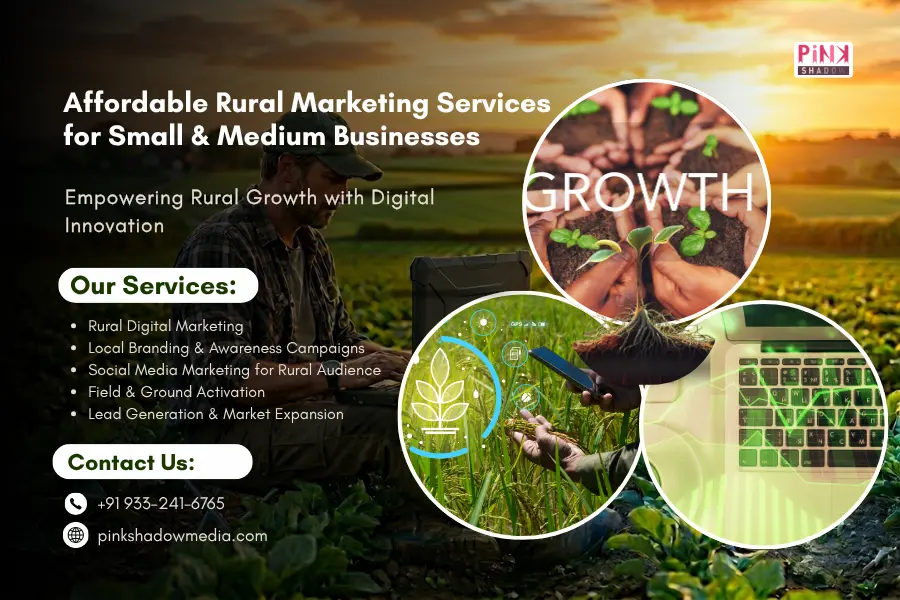
Affordable Rural Marketing Solutions for Small & Medium Businesses

Rural and semi-urban markets offer significant growth opportunities for small and medium-sized businesses. As smartphone usage, internet access, and digital adoption continue to grow, customers in smaller towns and rural communities are increasingly discovering products, comparing options, and communicating with brands through digital channels.
However, reaching these audiences effectively does not always require a large marketing budget. The key is to choose the right locations, understand local customer behavior, use relevant communication, and focus marketing resources on channels that can generate meaningful results.
For businesses that want to expand into rural markets without overspending, affordable rural marketing solutions can provide a practical way to build awareness, generate inquiries, and develop long-term customer relationships.
Why Rural Marketing Matters for Small and Medium Businesses
Large brands often have the resources to run nationwide campaigns, but small and medium businesses may need a more focused approach.
Rural marketing allows businesses to concentrate their efforts on specific regions, communities, customer groups, and distribution markets instead of spending their entire budget on broad campaigns.
A focused rural marketing strategy can help businesses:
- Reach customers in selected rural and semi-urban markets
- Build awareness in specific geographic areas
- Communicate in regional languages
- Generate local inquiries and leads
- Support dealers and distributors
- Promote products through digital and traditional channels
- Test new markets with controlled budgets
For businesses that need broader rural campaign planning, a rural marketing agency in India can help develop strategies around the target market, audience, budget, and business objectives.
Affordable Rural Marketing Strategies
Affordable rural marketing does not mean using fewer marketing activities without a strategy. Instead, it means allocating the available budget where it can create the most relevant reach and engagement.
Here are several practical strategies small and medium businesses can consider.
1. Focus on Regional and Hyperlocal Digital Marketing
Instead of targeting an entire state or country, businesses can begin with selected districts, towns, or communities where their products have the strongest potential.
Location-based digital campaigns can help control advertising costs while reaching a more relevant audience.
For example, a business selling agricultural products could start by targeting districts where the relevant crops are widely cultivated. A local consumer brand could focus on towns where it already has distributors or retail availability.
This approach makes it easier to test campaign performance before increasing the budget.
2. Use Social Media to Build Rural Brand Awareness
Social media can be a cost-effective way for smaller businesses to maintain regular communication with rural audiences.
Facebook, Instagram, YouTube, and WhatsApp can be used to share:
- Product information
- Educational content
- Short videos
- Customer experiences
- Product demonstrations
- Local offers
- Frequently asked questions
- Seasonal messages
For brands targeting rural communities, social media marketing for rural brands can help create consistent awareness and engagement without relying entirely on expensive traditional advertising.
The focus should be on useful and locally relevant content rather than simply increasing the number of posts.
3. Create Regional-Language Content
Language plays an important role in rural communication.
Businesses can make their marketing more accessible by creating content in the language commonly used by their target audience. This can include social media posts, videos, advertisements, product information, and WhatsApp messages.
Regional-language content can help businesses communicate:
- Product benefits
- Usage instructions
- Offers and promotions
- Educational information
- Frequently asked questions
- Brand messages
Localization should not be limited to translating English content. The message should also reflect local communication styles, customer needs, and cultural context.
4. Use WhatsApp Marketing for Direct Communication
WhatsApp can be useful for small and medium businesses because it allows direct communication with customers, dealers, retailers, and other stakeholders.
Businesses can use WhatsApp to share:
- Product updates
- Offers
- New product announcements
- Product catalogues
- Videos
- Educational information
- Customer support messages
However, businesses should avoid sending excessive promotional messages. Communication should be relevant and permission-based so that customers continue to find the channel useful.
5. Work With Local Influencers and Community Voices
Local influencers, community figures, retailers, agricultural professionals, and other trusted voices can help businesses communicate with specific rural audiences.
Instead of investing heavily in large influencer campaigns, small businesses can identify relevant local voices whose audience matches their target market.
For example, a business could collaborate with a regional content creator to demonstrate a product or explain its benefits in a familiar local language.
The goal should be relevance and trust rather than simply choosing an influencer based on follower count.
Rural Digital Marketing for Agriculture Businesses
Agriculture is an important part of many rural markets, creating opportunities for businesses involved in seeds, fertilizers, crop protection, irrigation, agricultural equipment, animal feed, and other farming-related products.
Agriculture-focused businesses can use digital channels to educate farmers and support product awareness.
A rural digital marketing for agriculture businesses strategy can include:
- Farmer-focused social media content
- Regional-language videos
- Product demonstration videos
- Educational blogs
- Search engine optimization
- Meta advertising
- WhatsApp communication
- Location-based campaigns
For example, an agricultural business could create a short video explaining a common crop-related problem, promote that video to relevant districts, and direct interested users to a product or inquiry page.
This approach connects education with product awareness while keeping the campaign focused.
Digital Marketing for Agriculture and Rural Markets
Agriculture businesses often need communication that is more educational and practical than conventional consumer advertising.
A specialized agriculture marketing agency in India can help businesses plan digital campaigns around farmers, agri-retailers, distributors, and other agricultural stakeholders.
The strategy may include:
- Search marketing
- Social media management
- Video marketing
- Content marketing
- Lead generation
- Regional communication
- Performance advertising
- Landing-page optimization
The exact combination should depend on the product, target audience, market area, and available budget.
Combining Digital and Local Marketing
Digital marketing can be powerful, but rural markets can also benefit from local and offline communication.
Small and medium businesses can combine online campaigns with activities such as:
- Local events
- Dealer promotions
- Retailer communication
- Community activities
- Outdoor advertising
- Product demonstrations
- Local partnerships
- Field-level promotions
For example, a company launching a product in a particular district could use social media advertising to create awareness before conducting a local product demonstration.
This combination can help connect digital visibility with physical presence.
How to Plan a Rural Marketing Budget
A limited budget does not mean that a business should avoid rural marketing. It means the budget should be allocated carefully.
A practical approach is to divide the campaign into three stages:
Stage 1: Market Testing
Start with a limited number of locations and audiences.
Test different messages, creatives, content formats, and advertising channels.
Stage 2: Performance Analysis
Measure which campaigns are generating useful engagement, inquiries, website visits, or conversions.
Stage 3: Budget Expansion
Increase investment in campaigns that demonstrate meaningful business results.
This approach allows businesses to learn from smaller campaigns before committing to larger marketing budgets.
Measuring Rural Marketing Performance
Businesses should measure rural marketing based on their actual objectives.
Depending on the campaign, useful metrics may include:
- Website traffic
- Organic search impressions
- Keyword rankings
- Lead form submissions
- WhatsApp inquiries
- Phone calls
- Social media engagement
- Video views
- Advertising reach
- Cost per lead
- Conversion rate
- Product inquiries
For example, if the objective is lead generation, the number and quality of inquiries may be more useful than simply looking at impressions or follower growth.
Regular measurement also helps businesses identify which locations and audience segments are responding most effectively.
Rural Marketing for Different Types of Businesses
Affordable rural marketing strategies can be adapted to different industries.
Agriculture Businesses
Agricultural companies can focus on farmer education, product demonstrations, regional-language content, dealer support, and targeted digital campaigns.
FMCG Businesses
FMCG brands can use local promotions, social media, retailer communication, and regional advertising to increase product awareness.
Consumer Service Businesses
Services can use location-based search campaigns, social media, WhatsApp, and local content to reach customers in specific towns and communities.
Manufacturing Businesses
Manufacturers can use digital content, B2B lead generation, dealer marketing, and regional campaigns to connect with distributors and business buyers.
The strategy should always be adapted to the buying process of the specific industry.
Building Rural Brand Awareness on a Practical Budget
Brand building does not always require large national advertising campaigns.
Small and medium businesses can gradually develop rural brand awareness by maintaining consistent messaging across their digital and local marketing channels.
Businesses can focus on:
- Consistent brand identity
- Useful educational content
- Regional communication
- Local customer engagement
- Product visibility
- Dealer relationships
- Community-level awareness
A rural brand promotion agency can support businesses in planning and coordinating these activities across relevant markets.
The objective is to create repeated, meaningful interactions with the target audience rather than relying on a single campaign.
Why a Focused Approach Can Be More Practical
One of the biggest advantages of an affordable rural marketing strategy is flexibility.
A small business does not necessarily need to compete with large brands on advertising volume. Instead, it can focus on specific markets where it has a strong product-market fit.
A focused strategy allows businesses to:
- Start with manageable budgets
- Test individual markets
- Understand customer response
- Improve campaigns gradually
- Reduce unnecessary advertising expenditure
- Scale successful activities
This makes rural marketing more accessible for businesses that are still developing their market presence.
How Pink Shadow Media Supports Affordable Rural Marketing
Pink Shadow Media develops digital marketing strategies that can be adapted to different business sizes, target markets, and budgets.
The approach can include SEO, social media marketing, content creation, digital advertising, video marketing, regional communication, and lead-generation campaigns.
For small and medium businesses, the focus is on creating practical campaigns rather than spending the entire budget across multiple channels without a clear objective.
By understanding the target audience, selecting relevant markets, and measuring campaign performance, businesses can gradually build their rural presence while keeping their marketing investment controlled.
Frequently Asked Questions
1. What is affordable rural marketing?
Affordable rural marketing focuses on reaching rural and semi-urban audiences through cost-conscious strategies such as localized digital advertising, social media, regional-language content, WhatsApp marketing, and targeted local promotions.
2. Can small businesses benefit from rural marketing?
Yes. Small businesses can use focused rural marketing to target specific locations and customer groups instead of investing in broad campaigns.
3. What is the most cost-effective rural marketing strategy?
There is no single strategy that works for every business. Regional digital marketing, social media, localized content, WhatsApp communication, and targeted advertising can all be useful depending on the audience and objective.
4. How can businesses reach rural customers online?
Businesses can use SEO, social media, video marketing, regional-language content, Google Ads, Meta Ads, and WhatsApp to reach relevant rural audiences.
5. Is social media effective for rural marketing?
Social media can help businesses build awareness and maintain regular communication with rural audiences, particularly when the content is relevant, localized, and easy to understand.
6. Why is regional-language content important in rural marketing?
Regional-language content can make information easier to understand and help businesses communicate more naturally with local audiences.
7. How much should a small business spend on rural marketing?
There is no fixed budget. Businesses should determine their budget based on their market size, product, objectives, competition, and available resources. Starting with a controlled test budget can help identify effective channels before scaling.
8. Can agriculture businesses use affordable rural marketing?
Yes. Agriculture businesses can use educational content, social media, regional-language videos, search marketing, targeted advertising, and WhatsApp communication to reach farmers and other agricultural stakeholders.
9. How can rural marketing campaigns be measured?
Campaigns can be measured through website traffic, leads, inquiries, engagement, advertising conversions, cost per lead, search visibility, and other business-specific metrics.
10. Should small businesses combine digital and traditional rural marketing?
Depending on the target market, combining digital channels with local events, dealer activities, product demonstrations, and other offline initiatives can create broader market coverage.
Conclusion
Affordable rural marketing is not about reducing marketing activity—it is about using available resources more strategically.
Small and medium businesses can begin with focused locations, localized content, social media, targeted advertising, WhatsApp communication, and relevant local activities. Performance can then be measured and successful campaigns gradually expanded.
With the right planning, rural markets can become an important part of a business's long-term growth strategy without requiring an unnecessarily large marketing budget.
Pink Shadow Media helps businesses develop practical digital and rural marketing strategies based on their target audiences, markets, products, and growth objectives.

Let’s Elevate Your Digital Presence
You have a powerful story; We provide the strategy, creativity, and technology to handle all your marketing needs under one roof. Ready to see results?

