

Address
18, Bahir Sarbamangala Road, Punjabi Para, Subhas Pally, East Burdwan, West Bengal, India - 713101
Get In Touch
9332416765
Mail Us
info@pinkshadowmedia.com
Recent Blogs
October 24, 2026
October 16, 2026
 Change Language

Agriculture Digital Agency vs Traditional Marketing: Which Is Better for Farming Businesses?

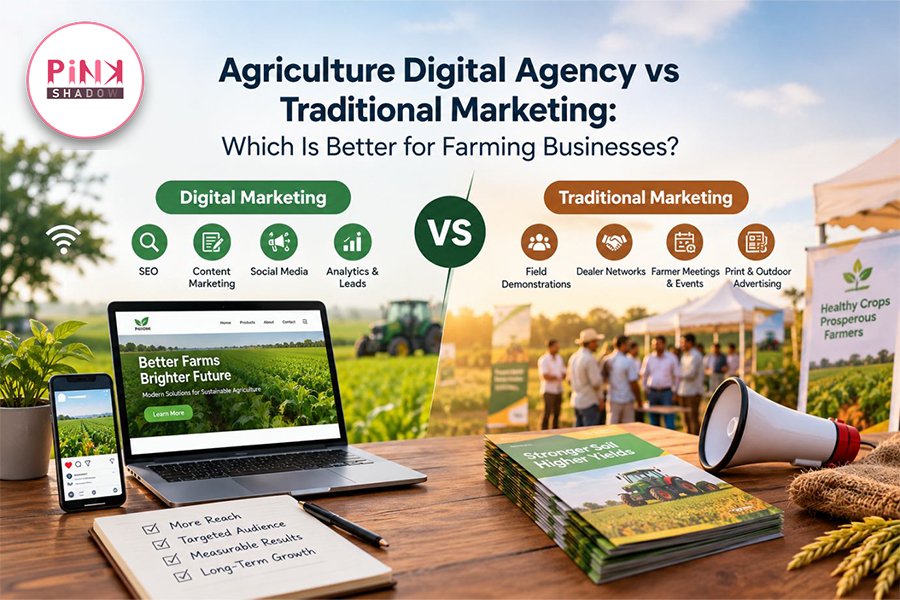
The agriculture industry is changing. Farmers, agri-input companies, seed manufacturers, fertilizer brands, agricultural equipment suppliers, and food producers are increasingly using digital platforms to discover products, compare solutions, and connect with businesses. At the same time, traditional marketing methods such as field demonstrations, dealer networks, local events, print advertising, and farmer meetings remain important for building trust.
This creates an important question for agricultural businesses: should you invest in an agriculture digital marketing agency, continue with traditional marketing, or combine both approaches?
The right decision depends on your target audience, business goals, budget, location, and the type of agricultural products you offer. Digital marketing can help businesses reach specific audiences and measure campaign performance, while traditional marketing can create direct connections with farmers and local communities.
In this guide, we compare both approaches, explain their advantages and limitations, and explore how farming businesses can build a sustainable marketing strategy for long-term growth.
What Is an Agriculture Digital Marketing Agency?
An agriculture digital marketing agency helps agricultural businesses promote their products and services through online channels. Instead of relying only on offline advertising, it uses search engines, websites, social media, online videos, and digital advertising to reach relevant audiences.
An Agriculture marketing Agency may support businesses such as:
- Seed, fertilizer, and pesticide manufacturers.
- Agricultural machinery and irrigation equipment suppliers.
- Organic farming and sustainable agriculture brands.
- Agritech startups and farm management platforms.
- Rice mills, food processors, and agricultural distributors.
- Agricultural retailers and rural-focused businesses.
The objective is not simply to generate website traffic. It is to attract relevant customers, educate potential buyers, generate qualified inquiries, and support sales.
For example, an irrigation equipment company could publish helpful content about water-saving irrigation systems, optimize its product pages for relevant searches, and use targeted campaigns to reach distributors or farmers in its service areas.
This approach connects marketing activities with the actual needs of the agricultural market.
What Is Traditional Marketing in Agriculture?
Traditional agricultural marketing involves offline promotional activities that help businesses connect with farmers, distributors, retailers, and rural communities.
These methods remain useful because agricultural purchasing decisions often depend on product demonstrations, recommendations, seasonal requirements, local availability, and personal relationships.
Common traditional marketing methods include:
- Field demonstrations: Showing how seeds, equipment, or farming products work under practical conditions.
- Dealer and distributor networks: Promoting products through local retailers and agricultural suppliers.
- Farmer meetings: Organizing educational sessions, product presentations, and community discussions.
- Print advertising: Using newspapers, agricultural magazines, brochures, and leaflets.
- Outdoor advertising: Promoting products through banners, signboards, wall branding, and local displays.
- Agricultural events: Participating in trade fairs, exhibitions, and farming-related events.
Traditional marketing can be particularly valuable when customers need to see a product in action or speak directly with a representative before making a purchase.
However, measuring the exact contribution of individual offline campaigns can be difficult without proper tracking methods.
Agriculture Digital Agency vs Traditional Marketing: Key Differences
Both approaches can support agricultural businesses, but they differ in reach, measurement, targeting, and customer engagement
|
Comparison factor |
Digital marketing |
Traditional marketing |
|
Audience reach |
Can reach local, national, and international audiences online | Audience reachOften concentrated in selected locations or distribution areas |
| Targeting | Can target audiences using search intent, location, interests, and campaign data | Usually relies on location, event attendance, distribution networks, or publication readership |
| Performance tracking | Website visits, leads, calls, clicks, and conversions can be tracked | Often requires surveys, unique phone numbers, coupon codes, or dealer feedback |
| Customer engagement | Search content, videos, social media, and online inquiries | Face-to-face conversations, demonstrations, and local events |
| Budget flexibility | Campaigns can often be adjusted based on available budgets and results | Printing, travel, event, and placement costs may require advance commitments |
| Long-term value | Useful content and organic search visibility can continue attracting visitors | Materials and events often have a shorter active promotional period |
| Trust building | Can build trust through educational content, reviews, case studies, and demonstrations shared online | Can build trust through personal relationships and physical product experiences |
Neither channel guarantees sales. Results depend on the quality of the message, product relevance, execution, distribution, and the ability to convert interest into actual purchases.
1. Benefits of Digital Marketing for Agriculture Businesses
Digital marketing gives agricultural brands additional ways to reach potential customers before they contact a salesperson or visit a dealer.
Better visibility on search engines
Farmers, distributors, and agricultural buyers may search online for product information, suppliers, technical guidance, or solutions to specific farming problems.
Search engine optimization (SEO) helps businesses create useful pages that answer these questions.
For example, an agricultural equipment supplier could create content about drip irrigation systems, equipment maintenance, or selecting machinery for different farm sizes.
Well-optimized pages can attract relevant visitors over time without requiring payment for every click. However, rankings and traffic are not guaranteed, and results usually require consistent technical maintenance and useful content.
Educational content that supports buying decisions
Agricultural products often require explanation before a customer understands their benefits or appropriate use.
A business can use blogs, product guides, explainer videos, and frequently asked questions to address common concerns.
Useful content topics might include:
- How to select suitable irrigation equipment.
- What to consider when comparing agricultural machinery.
- How to evaluate seed quality using reliable product information.
- How agricultural distributors can assess suppliers.
What farmers should know before investing in a new farming technology.
Content should be accurate, relevant to the intended audience, and reviewed by knowledgeable agricultural professionals when it involves technical or safety-sensitive recommendations.
More measurable lead generation
A digital campaign can direct prospective buyers to a landing page, product catalog, inquiry form, or contact number.
Businesses can then monitor how many people visit, submit inquiries, request quotations, or contact a sales representative.
This information helps marketing teams identify which channels attract useful leads and where potential customers leave the buying process.
Wider market opportunities
An agricultural company that mainly serves one district may want to expand into neighboring states or other markets.
An effective digital strategy can help the business reach new audiences through localized landing pages, search optimization, educational videos, and targeted campaigns.
Expansion should be supported by relevant distribution, delivery, service, and language capabilities. Online visibility alone does not create a reliable sales network.
2. Benefits of Traditional Marketing for Farming Businesses
Despite the growth of digital channels, traditional marketing remains an important part of agricultural promotion.
Direct relationships with farmers and dealers
Agricultural purchases can involve significant costs and practical risks. Buyers may want to ask questions, inspect products, understand after-sales support, or hear from people who have used them.
Field visits, dealer meetings, and demonstrations provide opportunities to address these concerns directly.
Product demonstrations and local experiences
Some products are easier to evaluate in person than through a website.
Machinery, irrigation systems, farm equipment, and certain agricultural technologies may benefit from demonstrations that show how they work in real conditions.
These experiences can also generate photographs, videos, customer questions, and feedback that businesses can later use in their digital campaigns, with appropriate consent.
Reaching audiences through established local networks
Not every prospective customer regularly searches online or uses the same digital platforms.
Local retailers, agricultural events, community meetings, and printed materials can help businesses reach customers through existing networks.
This is particularly relevant when a business relies on regional distribution and personal relationships.
Limitations of traditional marketing
Traditional marketing can be effective, but businesses should consider its limitations.
Measuring the direct return from an event or print campaign can be challenging.
Reaching new markets may require additional travel, staff, and distribution expenses.
Printed materials can become outdated when product information changes.
Offline campaigns may have limited reach beyond their selected locations.
Following up with interested prospects can be difficult without a lead management process.
These limitations do not make traditional marketing ineffective. They highlight the importance of setting clear goals and tracking results.
3. Which Marketing Strategy Is More Cost-Effective?
There is no universal answer. The most cost-effective strategy is the one that generates meaningful business outcomes relative to the resources invested.
Digital marketing may be suitable for businesses seeking ongoing search visibility, measurable inquiries, and opportunities to reach customers across multiple locations.
Traditional marketing may be more effective when the main objective is to demonstrate a product, establish dealer relationships, or engage a local farming community.
Consider a hypothetical agricultural equipment company.
The company spends money on local demonstrations and receives inquiries from farmers and dealers. It also invests in SEO and educational videos to help potential customers discover its products online.
By tracking both activities, the company can compare the cost per qualified lead, the number of inquiries that become sales, and the revenue associated with each campaign.
A simple calculation is:
Cost per qualified lead = Total marketing cost ÷ Number of qualified leads
For example, if a campaign costs ₹30,000 and generates 30 qualified leads, the cost per qualified lead is ₹1,000.
This figure alone does not determine profitability. Businesses should also consider lead quality, conversion rates, average order value, profit margins, and repeat purchases.
Rather than choosing a channel based on assumptions, compare actual performance over a suitable period.
4. Why SEO Matters for Long-Term Agricultural Marketing
Paid advertising can generate visibility while campaigns are running. SEO offers a different opportunity: earning relevant organic traffic through useful pages that match what people are searching for.
For agricultural businesses, a long-term SEO strategy should focus on search intent rather than publishing large numbers of similar articles.
Build pages around real customer needs
Start by identifying what different audiences want to accomplish.
A farmer may need practical product information, while a distributor may be looking for manufacturers, pricing details, supply capabilities, or partnership opportunities.
Create pages that address these different needs instead of trying to target every audience with one generic article.
Use keyword research to identify opportunities
Research search queries related to products, services, locations, common problems, and buying decisions.
The focus keyword Agriculture marketing Agency can support content aimed at businesses looking for agricultural marketing services. However, it should only be used where it fits the reader's intent.
Related phrases such as Agriculture Digital Marketing Agency, Digital Marketing for Agriculture Business, and Digital Marketing agency for Agri can help identify relevant subtopics.
Use these phrases naturally in suitable sections. Avoid repeating them in every heading or paragraph.
Improve existing content before creating more
Publishing additional articles is not always the best way to increase organic traffic.
Review existing pages in Google Search Console to identify:
- Pages receiving impressions but few clicks.
- Relevant queries where a page already appears in search results.
- Pages that attract visitors but generate few inquiries.
- Similar articles competing for the same search intent.
- Outdated information, broken internal links, and missing product details.
Update pages when you can provide a meaningful improvement. This might include clearer explanations, more accurate information, stronger internal links, better examples, or a more useful page structure.
Avoid making superficial changes solely to give a page a new publication date.
Demonstrate real agricultural knowledge
Google's people-first content principles emphasize helpfulness, reliability, and a clear focus on the audience.
Agricultural businesses can strengthen their content by including practical product experience, original photographs, expert review, customer questions, and real examples where available.
Do not invent customer testimonials, performance statistics, case studies, or agricultural expertise.
These practices help create content that is useful to readers and gives them stronger reasons to trust the business.
5. How an Agriculture Digital Marketing Agency Can Support Growth
Working with an experienced marketing partner can help an agricultural business coordinate several activities rather than treating every promotional channel separately.
A suitable agency may provide the following services.
Search engine optimization
SEO can improve the discoverability of product pages, service pages, educational resources, and relevant local landing pages.
Activities may include technical SEO, keyword research, on-page optimization, internal linking, and performance analysis.
Content marketing
Content marketing can explain products, address common customer questions, and help buyers evaluate different solutions.
The focus should be on quality, accuracy, and search intent rather than producing a large volume of repetitive articles.
Social media marketing
Social media can help agricultural brands share product demonstrations, educational information, event updates, and business news.
Choose platforms based on where the intended audience is active and the type of content the business can produce consistently.
Video production
Video can demonstrate how a product works, introduce a business, explain product features, or document field activities.
Videos can also support website content, social media campaigns, and sales presentations.
Paid advertising and lead generation
Search and social advertising can help businesses test offers, reach selected audiences, and generate inquiries.
Campaigns should have clear conversion goals and a follow-up process so that sales teams can assess lead quality.
Rural and agricultural marketing integration
Agricultural promotion often requires more than online visibility.
A coordinated strategy can connect digital campaigns with dealer activities, rural events, field demonstrations, and local brand promotion.
Pink Shadow Media offers a range of digital marketing and promotional services relevant to businesses exploring these approaches. Agricultural brands should assess any prospective agency's capabilities, industry understanding, reporting practices, and suitability for their particular goals before making a decision.
6. Digital Marketing vs Traditional Marketing: Which Should You Choose?
The right approach depends on your business model, target market, and immediate priorities.
Choose digital marketing as a priority when:
- You want to increase organic visibility for products and services.
- Your potential customers search online before contacting suppliers.
- You need to generate and track inquiries across multiple locations.
- You want educational content that supports buyers throughout their decision-making process.
- You plan to build a long-term online presence.
Prioritize traditional marketing when:
- Customers need to inspect or test products before purchasing.
- Your business depends heavily on dealer and distributor relationships.
- Field demonstrations are central to explaining product value.
- You want to build awareness in a defined local community.
- You participate in agricultural exhibitions or farmer meetings.
Combine both approaches when:
- You need online visibility as well as personal customer relationships.
- Your product requires explanation and practical demonstration.
- You want to extend the reach of local events beyond attendees.
- Your sales process involves several steps, from awareness to product evaluation and purchase.
For many farming businesses, an integrated strategy is the most practical option because it connects online discovery with real-world product experience.
7. How to Build a Long-Term Agricultural Marketing Plan
A sustainable marketing plan should be based on measurable goals and customer needs, not simply on the number of campaigns or articles published.
Step 1: Define your business objectives
Decide whether you want to generate distributor inquiries, sell products directly, expand into new locations, improve brand awareness, or increase qualified leads.
Each objective may require a different channel mix.
Step 2: Understand your audience
Identify your main customer groups, their buying concerns, their preferred languages, and how they research agricultural products.
Consider differences between farmers, dealers, institutional buyers, and agribusiness companies.
Step 3: Establish a strong website foundation
Make sure your website clearly explains your products, services, contact options, geographic coverage, and relevant business information.
Review mobile usability, page speed, indexing, internal links, and technical SEO issues.
Step 4: Create a focused content plan
Prioritize a small group of useful pages that cover important product categories, customer questions, and buying decisions.
Map each main search intent to the most appropriate page. This helps reduce unnecessary keyword overlap and makes internal linking more meaningful.
Step 5: Connect digital and offline activities
Use QR codes, trackable landing pages, dedicated campaign phone numbers, or simple inquiry records to measure responses to offline promotions.
For example, a field demonstration could direct attendees to a product guide or dealer inquiry form. The business can then evaluate whether the activity generates useful follow-up conversations.
Step 6: Measure results and improve
Review organic clicks, relevant impressions, qualified leads, conversion rates, sales outcomes, and marketing costs.
Use Google Search Console to understand organic search performance and suitable analytics or CRM tools to assess visitor behavior and lead quality.
Evaluate performance over an appropriate period. Seasonal demand, crop cycles, weather conditions, and regional differences can affect agricultural marketing results.
The goal is to improve what works, remove ineffective activities, and build a repeatable system that supports long-term growth.
Conclusion: Which Approach Is Better for Farming Businesses?
Agriculture digital marketing and traditional marketing serve different but complementary purposes. Digital marketing can improve online discoverability, provide measurable lead generation opportunities, and help agricultural businesses reach customers beyond their immediate locations. Traditional marketing remains valuable for personal relationships, local awareness, and hands-on product demonstrations.
For many businesses, the strongest strategy combines both methods according to customer needs, available resources, and measurable outcomes.
Choosing the right Agriculture marketing Agency can help bring these activities together through SEO, content marketing, social media, video production, lead generation, and rural promotional campaigns.
At Pink Shadow Media, the emphasis should be on helping agricultural brands build a focused marketing strategy that supports relevant organic traffic, customer trust, and sustainable business growth—not simply publishing more content.
The best starting point is to understand your audience, improve your existing digital presence, track your current marketing results, and invest in the activities most likely to support your business objectives.
FAQs
1. What is an agriculture digital marketing agency?
An agriculture digital marketing agency helps farming businesses and agricultural brands promote their products online through SEO, content marketing, social media, video, paid advertising, and lead generation.
2. Is digital marketing effective for farming businesses?
Yes, digital marketing can help farming businesses improve online visibility, educate potential buyers, attract relevant inquiries, and reach new markets. Results depend on the target audience, product, strategy, and execution.
3. Is traditional marketing still useful in agriculture?
Yes. Field demonstrations, farmer meetings, agricultural exhibitions, dealer networks, and print promotions remain useful for building local relationships and demonstrating products.
4. Which is better: digital marketing or traditional marketing?
Neither approach is universally better. Digital marketing supports online discovery and measurable campaigns, while traditional marketing supports direct engagement and physical demonstrations. The right choice depends on business goals and customer behavior.
5. How much does agricultural digital marketing cost?
Costs vary according to the scope of work, competition, geographic coverage, content requirements, advertising budget, and campaign objectives. Businesses should request a clear proposal that separates service fees from advertising spend where applicable.
6. How can SEO help an agricultural business?
SEO can help an agricultural business appear for relevant searches, attract potential customers to product and service pages, answer customer questions, and build organic visibility over time.
7. What services should I look for in an Agriculture Digital Marketing Agency?
Look for relevant SEO, content marketing, website optimization, social media management, video production, lead generation, analytics, and reporting capabilities. Choose services based on your actual business needs rather than buying every available service.
8. How long does agricultural SEO take to show results?
SEO timelines vary based on competition, website condition, content quality, authority, and search demand. Meaningful improvements may take several months, and sustainable results require ongoing monitoring and improvement.
9. How can I measure the success of an agricultural marketing campaign?
Track relevant website traffic, qualified inquiries, calls, conversion rates, cost per lead, sales, and revenue where attribution is possible. For offline activities, use trackable contact methods and collect feedback from dealers or event participants.
10. How can farming businesses combine digital and traditional marketing?
Businesses can promote field demonstrations through social media, share event videos online, direct print-ad readers to useful website pages, and use trackable links or QR codes to measure responses. This connects local engagement with ongoing digital visibility.

Let’s Elevate Your Digital Presence
You have a powerful story; We provide the strategy, creativity, and technology to handle all your marketing needs under one roof. Ready to see results?

