

Address
18, Bahir Sarbamangala Road, Punjabi Para, Subhas Pally, East Burdwan, West Bengal, India - 713101
Get In Touch
9332416765
Mail Us
info@pinkshadowmedia.com
Recent Blogs

October 24, 2026

October 16, 2026
 Change Language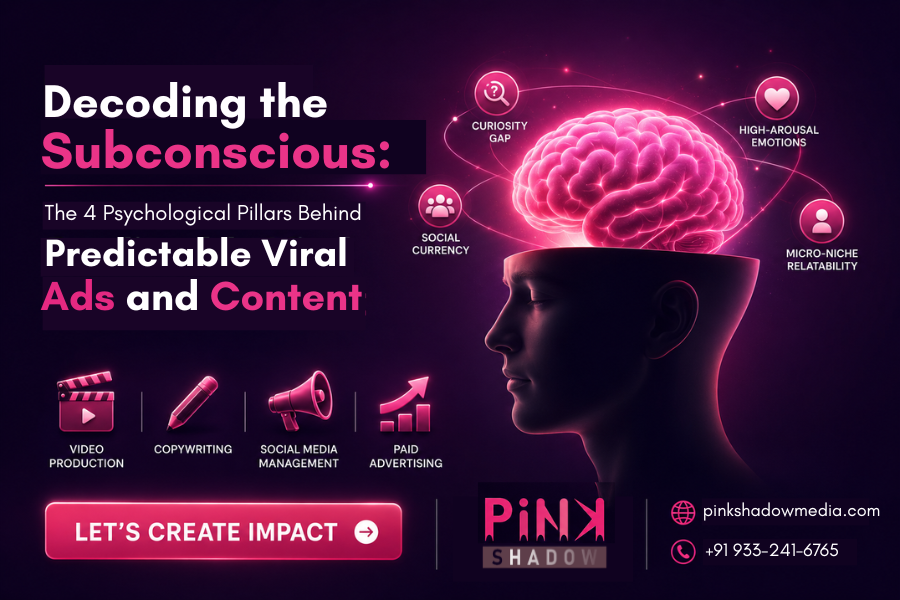
Decoding the Subconscious: The 4 Psychological Pillars Behind Predictable Viral Ads and Content

Virality Isn't Luck—It's Psychology
Why do some ads explode with millions of views while others disappear without making an impact?
Many marketers blame algorithms. Others assume the content simply got lucky. But the reality is far more fascinating.
Behind every viral campaign lies a deep understanding of human psychology.
Before someone clicks "Share," saves a post, tags a friend, or leaves a comment, their brain goes through a series of subconscious evaluations. The most successful brands understand these hidden triggers and build their content around them.
In today's digital landscape, Consumer Behavior and Cognitive Psychology have become some of the most powerful tools in marketing. When used correctly, they transform content creation from guesswork into a strategic process.
Let's explore the four psychological pillars that consistently appear in high-performing advertisements, viral videos, and engaging social media campaigns.
Pillar 1: The Curiosity Gap & Information Deprivation
The Science Behind It
One of the strongest psychological triggers is curiosity.
Behavioral economist George Loewenstein introduced the Information Gap Theory, which suggests that when people recognize a gap between what they know and what they want to know, they experience a feeling of deprivation.
The brain dislikes unfinished information loops.
This is why people click headlines like:
- "The Marketing Mistake Costing Businesses Thousands Every Month"
- "The Hidden Reason Your Ads Aren't Converting"
- "What Most Brands Get Wrong About Customer Trust"
These statements create a knowledge gap that the brain feels compelled to close.
Actionable Framework: The 3-Second Psychological Hook
Most content fails because it tells people exactly what it contains.
For example:
❌ "5 Tips for Better B2B Sales"
Instead, create intrigue:
✅ "The Hidden Reason Your Sales Team Misses Targets Every Friday"
The second version creates a mystery.
The viewer immediately wants to know the answer.
When creating content, ask yourself:
- Does this create an unanswered question?
- Does it challenge a common belief?
- Does it reveal a hidden insight?
If yes, you are activating curiosity.
Pillar 2: Social Currency & Identity Projection
The Science Behind It
People don't just consume content. They use content to communicate who they are.
Marketing researcher Jonah Berger explains that people share things that make them appear knowledgeable, intelligent, informed, or connected.
Think about it.
- Why do professionals share industry reports?
- Why do people repost productivity hacks?
- Why do users forward unique insights to friends?
Because sharing becomes a form of identity projection.
The content acts like digital apparel.
It tells the world:
"I know something valuable."
Actionable Framework: The Shareability Audit
Before publishing any content, ask:
Does sharing this post make my audience look good?
If the answer is yes, the chances of organic distribution increase dramatically.
Examples:
- Industry insights
- Data-backed findings
- Exclusive knowledge
- Emerging trends
- Insider perspectives
The more valuable the content appears socially, the more likely people are to share it.
Remember:
People share content that enhances their reputation.
Pillar 3: The Neurological Activation of High-Arousal Emotions
The Science Behind It
Not all emotions drive action equally. Psychologists distinguish between low-arousal and high-arousal emotions.
Low-arousal emotions include:
- Contentment
- Relaxation
- Mild sadness
High-arousal emotions include:
- Awe
- Excitement
- Inspiration
- Amusement
- Surprise
- Righteous anger
When high-arousal emotions are activated, the body's sympathetic nervous system becomes more engaged. This physiological activation increases the likelihood of action.
And on social media, action means:
- Sharing
- Commenting
- Clicking
- Tagging friends
Actionable Framework for Content Creation
| High-Arousal Concepts | Low-Arousal Concepts |
|---|---|
|
Unexpected success stories |
General updates |
|
Dramatic transformations |
Routine information |
|
Humorous situations |
Neutral explanations |
|
Inspiring journeys |
Standard announcements |
|
Surprising facts |
Basic educational content |
For video production, ask:
"What emotional reaction do I want viewers to feel within the first 10 seconds?"
The stronger the emotional activation, the greater the engagement potential. This doesn't mean manufacturing emotion. It means identifying naturally emotional stories and presenting them effectively.
Pillar 4: Micro-Niche Relatability & The Belonging Effect
The Science Behind It
Humans have an innate need for validation and belonging. One of the most powerful reactions in marketing occurs when someone sees content and immediately thinks:
"That's exactly me."
The more specific the observation, the stronger the connection. Generic statements create weak engagement. Specific statements create emotional resonance.
For example:
❌ "Running a business is difficult."
✅ "You spent two hours designing a social media post, only for it to get three likes."
The second statement feels personal. It reflects a real experience. And that creates trust.
Actionable Framework: Mining Real Human Frustrations
The best marketing insights rarely come from brainstorming rooms. They come from customers.
Explore:
- Customer reviews
- Support tickets
- Social media comments
- Community forums
- Sales conversations
- Frequently asked questions
Look for recurring frustrations.
Look for hidden complaints.
Look for emotional language.
These insights become powerful foundations for content scripts, ad creatives, and campaign messaging.
When people feel understood, they pay attention.
Real-World Examples of Viral Psychology in Action
Example 1: Dove's Real Beauty Campaign
Dove's famous campaigns generated global attention by leveraging relatability and emotional connection. Instead of focusing solely on products, the brand highlighted insecurities and social perceptions experienced by everyday women.
The campaign activated:
✔ High-arousal emotions through inspiration
✔ Relatability through real-life experiences
✔ Social currency by encouraging meaningful discussions
The result was massive engagement and brand affinity.
Example 2: Airbnb's User Storytelling Approach
Airbnb frequently showcases authentic guest experiences and host stories. Rather than selling accommodation, they sell emotional experiences.
Their content often activates:
✔ Curiosity through unique travel stories
✔ Inspiration and awe
✔ Relatability through real people
✔ Shareability because viewers imagine themselves in similar situations
The storytelling becomes more powerful than traditional advertising.
The Real Secret Behind Consistent Virality
Many businesses search endlessly for algorithm hacks. But algorithms evolve constantly. Human psychology doesn't. The most successful campaigns understand how people think, feel, connect, and make decisions.
Whether you're creating social media content, running paid advertisements, producing videos, or building brand awareness, these four pillars provide a reliable framework:
- Curiosity Gap
- Social Currency
- High-Arousal Emotions
- Radical Relatability
Master these principles, and your content gains a much stronger chance of earning attention, engagement, and conversions.
Ready to Build Content Backed by Psychology?
Understanding the psychology behind viral content is one thing. Executing it consistently across creative strategy, video production, copywriting, social media management, and paid advertising is another.
At Pink Shadow Media, we combine marketing strategy, audience psychology, creative storytelling, and performance-driven advertising to help brands create content that doesn't just get views—it drives real business growth.
If you're ready to attract more attention, generate qualified leads, and build a stronger digital presence, our team is ready to help.
Book a strategy consultation with Pink Shadow Media today and discover how psychology-driven marketing can transform your brand's growth.

Let’s Elevate Your Digital Presence
You have a powerful story; We provide the strategy, creativity, and technology to handle all your marketing needs under one roof. Ready to see results?

