

Address
18, Bahir Sarbamangala Road, Punjabi Para, Subhas Pally, East Burdwan, West Bengal, India - 713101
Get In Touch
9332416765
Mail Us
info@pinkshadowmedia.com
Recent Blogs
October 31, 2026

October 28, 2026
 Change Language
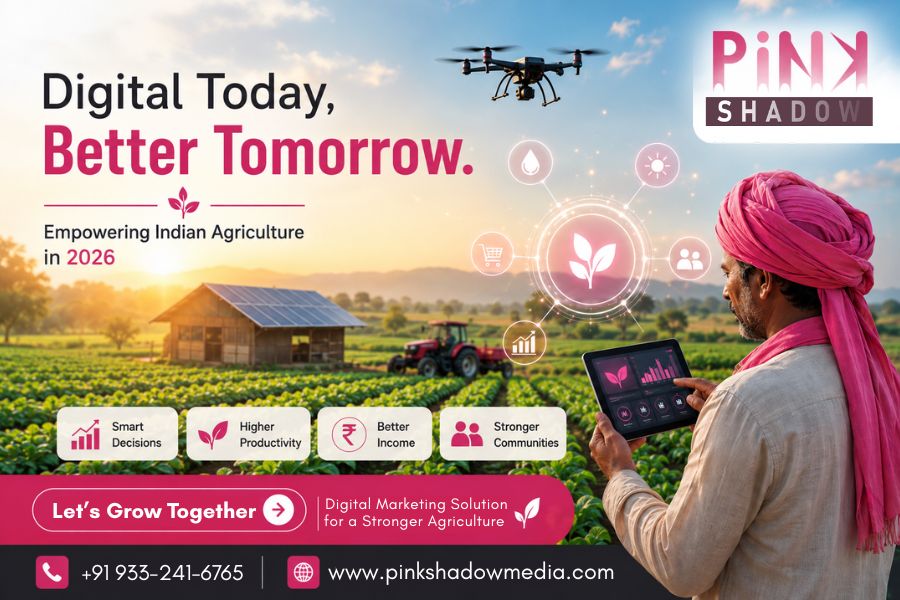
How Digital Marketing is Transforming Agriculture in India in 2026

India's agriculture sector is becoming increasingly connected to the digital world. Farmers, agri-input companies, seed manufacturers, fertilizer brands, pesticide companies, rice mills, agricultural equipment businesses, and food-processing companies are using digital channels to reach customers, build awareness, generate inquiries, and support long-term growth.
The change is not simply about advertising products online. Digital marketing for agriculture is helping businesses understand their audiences, communicate in regional languages, educate farmers, strengthen distribution networks, and create measurable customer journeys.
In 2026, agriculture businesses need a digital strategy that combines search, social media, video, WhatsApp, content, paid advertising, and data-driven decision-making. This article explains the major ways digital marketing is transforming agriculture in India and how agri businesses can use these opportunities effectively.
The Digital Transformation of Indian Agriculture
Agricultural businesses traditionally depended heavily on dealers, distributors, field representatives, exhibitions, print advertising, and on-ground demonstrations. These channels continue to have an important role, but digital platforms are adding new ways to reach farmers and agricultural buyers.
Smartphone usage, mobile internet, social media, online video, messaging platforms, and digital payments have changed how people discover information and communicate with businesses.
Farmers can now search for information about:
Seeds and crop varieties
Fertilizers and plant nutrition
Crop protection products
Agricultural machinery
Irrigation equipment
Farming techniques
Government schemes
Market prices
Agricultural suppliers
Crop disease solutions
For agriculture businesses, this creates an opportunity to become visible before a customer contacts a dealer or sales representative.
Why Digital Marketing Matters for Agriculture Businesses
Agriculture has a diverse customer ecosystem. A single product may need to reach farmers, retailers, distributors, dealers, agricultural professionals, and institutional buyers.
Digital marketing helps businesses communicate with different audiences through targeted content and campaigns.
Key benefits include:
Greater brand visibility
Better farmer education
More qualified inquiries
Stronger dealer and distributor communication
Regional audience targeting
Improved customer engagement
Better campaign measurement
Increased brand recall
Support for online and offline sales
A strong strategy should connect digital activity with actual business objectives rather than focusing only on impressions or followers.
1. Social Media Is Changing Agricultural Brand Communication
Social media has become an important communication channel for agricultural businesses.
Platforms such as Facebook, Instagram, YouTube, and WhatsApp can help brands explain products, demonstrate their use, share farmer stories, publish educational content, and communicate seasonal information.
For example, a fertilizer company can create content around:
Crop nutrition
Application methods
Seasonal farming tips
Product demonstrations
Farmer experiences
Crop-specific recommendations
This type of content can make technical agricultural information easier to understand.
Businesses can also use rural digital marketing for agriculture to adapt communication according to regional audiences, languages, farming practices, and local customer behaviour.
2. Video Marketing Makes Agricultural Information Easier to Understand
Agricultural products often require explanation. Farmers may want to understand how a product works, how it should be used, or what problem it addresses before making a purchase decision.
Video can demonstrate these concepts more effectively than text alone.
Useful formats include:
Product demonstrations
Farmer testimonials
Crop management videos
Expert interviews
Field demonstrations
Machinery tutorials
Before-and-after stories
Short educational videos
Regional-language explainers
YouTube and short-form video platforms also provide agriculture brands with opportunities to build an educational content library.
A consistent video strategy can support both brand awareness and customer education.
3. SEO Helps Agriculture Businesses Reach Customers at the Right Moment
Search engine optimization allows agricultural businesses to appear when potential customers are actively looking for information.
Searches may include terms such as:
Best fertilizer for rice cultivation
Agricultural equipment supplier
Paddy seed varieties
Irrigation equipment company
Organic farming products
Crop disease solutions
Fertilizer dealer near me
Agricultural product manufacturers
A properly optimized website can attract users throughout the customer journey.
For example:
Awareness:
"What is the best fertilizer for rice?"
Research:
"How does nitrogen fertilizer improve rice growth?"
Commercial investigation:
"Best fertilizer company for rice cultivation"
Purchase intent:
"Fertilizer supplier near me"
This is why SEO for agriculture companies should focus on useful content, search intent, technical optimization, and relevant commercial pages instead of relying on keyword repetition.
4. Content Marketing Is Educating Farmers and Agricultural Buyers
Agricultural customers need practical information.
Instead of creating content only around product promotions, brands can publish resources that answer real questions.
Examples include:
Crop guides
Farming calendars
Product usage guides
Pest management information
Irrigation tips
Fertilizer education
Crop-specific FAQs
Market insights
Agricultural technology updates
Farmer success stories
Educational content can help a company demonstrate knowledge while creating more opportunities to appear in search results.
It can also support sales teams by giving customers useful information before a direct conversation.
5. WhatsApp Is Connecting Agricultural Businesses With Customers
WhatsApp is particularly useful for direct communication.
Agriculture businesses can use WhatsApp to:
Share product catalogues
Send educational updates
Answer customer questions
Generate inquiries
Provide product information
Communicate with dealers
Share seasonal recommendations
Follow up with leads
A WhatsApp strategy can become even more effective when combined with landing pages, advertisements, CRM systems, and proper conversion tracking.
For businesses selling agricultural products, WhatsApp marketing for agri products can support both customer communication and lead nurturing.
6. Regional-Language Marketing Is Becoming More Important
Agriculture audiences are not homogeneous.
Language, crop patterns, farming practices, purchasing behaviour, and local market conditions can differ significantly between regions.
That means agricultural brands should consider localized communication.
Instead of translating the same advertisement word-for-word, businesses can adapt:
Language
Examples
Visuals
Crop references
Seasonal messages
Product explanations
Calls to action
Regional-language content can make agricultural communication easier to understand and more relevant to local audiences.
7. Paid Advertising Helps Agriculture Brands Reach Specific Audiences
Organic reach can take time. Paid advertising allows businesses to reach defined audiences more quickly.
Agriculture brands can use platforms such as Google and Meta to promote:
Product pages
Lead-generation forms
WhatsApp campaigns
Dealer recruitment
Product demonstrations
Educational webinars
Brand awareness campaigns
Seasonal offers
However, agricultural advertising should be carefully segmented.
A fertilizer campaign, for example, may need different messaging from an agricultural machinery campaign.
The objective should also determine the campaign structure—whether the goal is awareness, engagement, inquiries, dealer leads, or conversions.
8. Data Is Making Agricultural Marketing More Measurable
One of the biggest advantages of digital marketing is the ability to measure performance.
Agriculture businesses can track:
Website visitors
Search traffic
Lead volume
Cost per lead
Conversion rates
WhatsApp inquiries
Ad engagement
Landing-page performance
Regional performance
Customer acquisition sources
This data can help marketing teams identify which locations, products, audiences, and messages generate stronger results.
For example, if a campaign generates significantly more qualified inquiries from particular districts, the company can investigate whether those markets deserve additional investment.
9. Digital Marketing Is Supporting Rural Market Expansion
Rural markets remain important for many agriculture-related businesses.
Digital channels can complement traditional rural marketing rather than replacing it.
A campaign can combine:
Digital awareness → Local engagement → WhatsApp inquiry → Dealer connection → Offline purchase
This creates a bridge between online discovery and offline distribution.
For businesses targeting rural customers, an integrated approach can combine digital advertising, social media, local-language content, field activities, dealer communication, and regional campaigns.
10. Agriculture Marketing Agencies Are Becoming Strategic Partners
As digital channels become more specialized, agriculture businesses may need support from agencies that understand both marketing and agricultural audiences.
An experienced agriculture marketing agency in India can help businesses develop strategies around:
Search engine optimization
Social media marketing
Content marketing
Video production
Paid advertising
Lead generation
WhatsApp marketing
Rural audience targeting
Regional-language campaigns
Website optimization
Performance measurement
The value of an agency is not simply producing advertisements. The strategy should connect communication with the business's products, target audience, sales process, and market objectives.
Emerging Digital Marketing Trends in Agriculture for 2026
Several developments are shaping agricultural marketing in 2026.
Artificial Intelligence
AI can support content development, audience analysis, customer communication, campaign optimization, and marketing workflows.
Human expertise remains important, particularly when content involves agricultural recommendations or technical product information.
Voice Search
Voice-based searches can create opportunities for agricultural businesses to optimize content around natural-language questions and regional-language queries.
Hyperlocal Campaigns
Businesses can create campaigns focused on specific districts, farming clusters, crops, or market areas.
Personalized Communication
Customer data can help brands provide more relevant messages based on products, regions, interests, and customer stages.
Interactive Content
Calculators, quizzes, tools, comparison guides, and interactive resources can increase engagement and help users find relevant information.
Regional-Language Content
Localized content will remain important for communicating effectively with diverse agricultural audiences.
How Agriculture Businesses Can Build a Digital Marketing Strategy
A practical strategy can be built around six stages:
1. Understand the Audience
Identify farmers, dealers, distributors, retailers, institutional buyers, or other relevant groups.
2. Define the Business Objective
Decide whether the priority is awareness, leads, dealer inquiries, sales, customer education, or market expansion.
3. Build the Right Content
Create content that answers real customer questions and supports different stages of the buying journey.
4. Choose Relevant Channels
Use SEO, social media, video, WhatsApp, paid advertising, or other channels according to the audience and objective.
5. Connect Digital With Sales
Make sure online inquiries reach the appropriate sales team, dealer, distributor, or customer-support process.
6. Measure and Improve
Track meaningful KPIs and continuously improve campaigns based on actual performance.
Conclusion
Digital marketing is changing how agriculture businesses in India communicate with farmers, dealers, distributors, and other customers. SEO, social media, video, WhatsApp, regional-language content, paid advertising, and data analytics are creating new opportunities for agricultural brands to become more visible and accessible.
The most effective approach is not to treat digital marketing as a separate activity. It should work alongside sales, distribution, customer education, dealer networks, and on-ground marketing.
For agriculture businesses planning their next stage of growth, a well-structured digital strategy can create a stronger connection between agricultural products, customer needs, and measurable business opportunities.
Frequently Asked Questions
What is digital marketing for agriculture?
Digital marketing for agriculture uses online channels such as search engines, social media, websites, video platforms, WhatsApp, email, and paid advertising to promote agricultural products, services, and brands.
Why is digital marketing important for agriculture businesses?
It helps agriculture businesses reach relevant audiences, educate customers, generate inquiries, improve brand visibility, and measure marketing performance.
Which digital channels are useful for agriculture companies?
SEO, Google Ads, Facebook, Instagram, YouTube, WhatsApp, content marketing, email marketing, and regional-language digital campaigns can all be useful depending on the business objective.
How can SEO help an agriculture business?
SEO can help an agriculture business appear in search results when farmers, dealers, distributors, or other buyers search for products, suppliers, solutions, and agricultural information.
Is social media effective for agricultural brands?
Yes. Social media can help agricultural brands educate audiences, demonstrate products, publish farmer stories, build awareness, and generate inquiries.
How can WhatsApp help agriculture businesses?
WhatsApp can be used for product communication, customer support, lead follow-up, catalogues, dealer communication, seasonal updates, and direct inquiries.
Why is regional-language content important in agriculture marketing?
Agricultural audiences are spread across different regions and language groups. Localized content can make information easier to understand and more relevant to specific audiences.
What role does video marketing play in agriculture?
Video can demonstrate products, explain farming techniques, showcase field results, educate customers, and communicate technical information visually.
Should agriculture businesses use paid advertising?
Paid advertising can help businesses reach specific audiences, promote products, generate leads, and support market expansion when campaigns are properly targeted and measured.
What should an agriculture digital marketing strategy include?
A complete strategy can include audience research, SEO, content, social media, video, WhatsApp, paid advertising, regional marketing, conversion tracking, and ongoing performance optimization.

Let’s Elevate Your Digital Presence
You have a powerful story; We provide the strategy, creativity, and technology to handle all your marketing needs under one roof. Ready to see results?

